
Samuel Lajus & Xavier Coste – Kigali Night
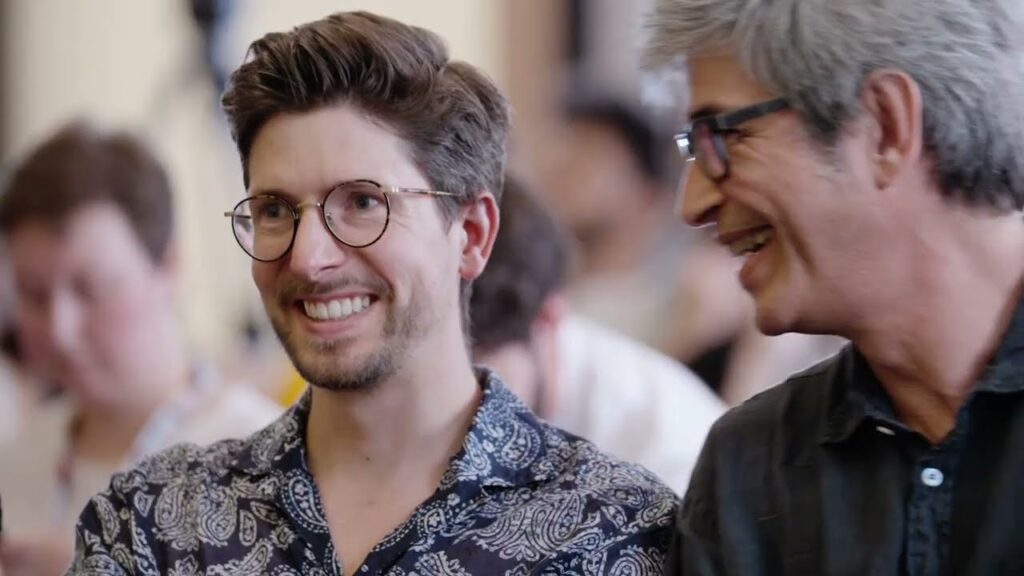
#AnnecyFestival #Residency #animation #AnnecyFestivalResidency
#Residence #KigaliNight #kigali #xaviercoste #samuellajus
Samuel Lajus
Director and Co-screenwriter of Kigali Night / France
Samuel Lajus studied “audiovisual techniques”. His military cooperation service in Rwanda (1991/92) paved the way for his dream of “one day working in documentary filmmaking”. In 2001, he edited his first documentary for Arte. That same year, he was asked to direct his first film: Génération FLNC for CANAL+ (in competition at FIPA 2003).
Since then, he has alternated between directing and editing, including Gonzalo Arijon’s Stranded (Joris Ivens Award 2007) and Kaouther Ben Hania’s Zaineb Hates the Snow (Tanit d’or at the Carthage Film Festival and Best Documentary at Cinemed 2016).
In terms of directing, most of his films deal with history, geopolitics and society.
With L’Ordre à tout prix (France 2, 2021), he questions our democracy and the right to demonstrate. With Interpol, une police sous influence ? (Arte, 2018), he examines the conflict of interest: can private companies, and even some undemocratic states, finance the “World Police”? And Les Roms, des citoyens comme les autres ?(Arte, 2017) looks at one aspect of Europe: Why is the situation of the Roma constantly deteriorating, despite Europe investing billions of euros?
It took Samuel 30 years to finally have the courage to address Rwanda. With Kigali Night, he takes us on a journey into his own story. To achieve this, he chose to combine fiction and animation. He worked with Romy Coccia di Ferro for the script and Xavier Coste for the graphics. He considers this film to be a significant achievement in terms of both subject and form. Why did he choose animation? For Samuel, it was the only expression that was suitable for the malleability of the material “memory”, for the subjectivity of memory and even for a deliberate lack of precision.
Xavier Coste
Artistic Director of Kigali Night / France
Born in Normandy in 1989, Xavier Coste is a comic book writer and illustrator. After studying graphic design, he released his first comic book in 2012, Egon Schiele: His Life and Death, published by Casterman and translated into several languages. This was followed by several comic books set in Paris, including Rimbaud l’indésirable and A comme Eiffel. His comic-book adaptation of George Orwell’s 1984, published in 2021 by Sarbacane, won the Albert-Uderzo Award for Best Contribution to the 9th Art as well as the Fnac France Inter Comic Book Award. The comic book has been translated into fifteen languages and is currently being adapted into a feature-length animation film.
Subsequently, he released his own sequel to Orwell’s novel: Journal de 1985, which was published in September 2024, and he is currently working on a comic book with Antoine de Caunes for Dargaud, scheduled for release in 2025.
Alongside comic books, he works as an illustrator for publishers and as an art director and storyboarder on feature film projects.
Published graphic novels:
Journal de 1985, Sarbacane, 2024
L’Homme à la tête de lion, Sarbacane, 2022
1984, Sarbacane, 2021
Based on the novel by George Orwell
A comme Eiffel, Casterman, 2019
Script by Martin Trystram
L’Enfant et la Rivière, Sarbacane, 2018
Based on the novel by Henri Bosco
Le Lendemain du monde, Casterman, 2017
Script by Olivier Cotte
À la dérive, Casterman, 2015
Rimbaud, l’indésirable, Casterman, 2013
Egon Schiele: Hs Life and Death, Casterman, 2012
///
Kigali Night
Director/Co-screenwriter: Samuel LAJUS (France)
Artistic Director: Xavier COSTE (France)
Co-screenwriter: Romy COCCIA DI FERRO (Italy/Lebanon)
Early screenwriting assistance: Grégoire POLET (Belgium)
Producers: Jérôme DUC-MAUGE (Parmi Les Lucioles, France), Virginie CHAPELLE and Samuel TILMAN (Eklektik productions, Belgium)
Samuel is 23 when he arrives as an audiovisual presenter at the French Cultural Centre in Kigali. During the 18 months he spends in Rwanda, the warning signs multiply, but Samuel chooses to ignore them. Everything he is told seems impossible to him: his country, France, could not possibly support such a regime. But this climate does not stop him from enjoying the country and partying. Then gradually his convictions begin to falter.
This account takes place two years before the genocide, a time that is rarely, if ever, discussed. However, it is during this period that everything falls into place.
source